| Cat # | Size | Price | Quantity | |
|---|---|---|---|---|
| 105601 | 100 ug | $50 | ||
| 105602 | 500 ug | $150 |
| Clone | 2H7 |
|---|---|
| Application | FC |
| Reactivity | Human |
| Format | Purified |
| Target Name | CD20, MS4A-1, MS4A1 |
| Isotype | Mouse IgG2b |
| Antibody Type | Monoclonal |
| Regulatory Status | RUO |
| Formulation | Phosphate-buffered solution, pH 7.2, containing 0.09% sodium azide |
| Protein Concentration | 0.5 mg/mL |
| Storage and Handling | The antibody solution should be stored between 2°C and 8°C |
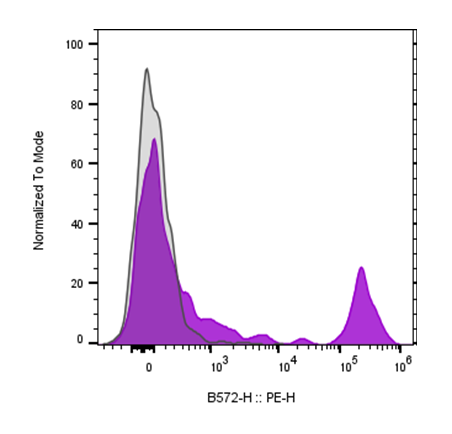
| Recommended Usage | For flow cytometric staining, it is recommended to use less than 0.25 ug of this reagent per 0.5-1.0 million cells in a 100 µL volume. Optimal reagent performance should be determined by titration for each specific application |
CD20 is a 33-37 kD, four transmembrane spanning protein, also known as B1 and Bp35. CD20 is expressed on pre-B-cells, resting and activated B cells (not plasma cells), some follicular dendritic cells, and at low levels on a T cell subset. CD20 is heavily phosphorylated on activated B cells and malignant B cells. Homo-oligomeric complexes of CD20 are thought to form Ca2+ conductive ion channels in the plasma membrane of B cells. The CD20 molecule is involved in B-cell activation and is associated with various Src family kinases (Lyn, Lck, Fyn). It exists in a complex with MHC class I and II, CD53, CD81, and CD82. The epitope recognized by clone 2H7 has been mapped to the sequence YNCEPANPSEKNSPST, which lies in the large extracellular loop of human CD20.
Have a product or application question? Consult our FAQs or contact us.