| Cat # | Size | Price | Quantity | |
|---|---|---|---|---|
| 101909 | 25 tests | $55 | ||
| 101910 | 100 tests | $140 |
| Clone | FN50 |
|---|---|
| Application | FC |
| Reactivity | Human |
| Format | iF647 |
| Target Name | CD69, Very Early Activation Antigent (VEA) |
| Isotype | Mouse IgG1 |
| Antibody Type | Monoclonal |
| Regulatory Status | RUO |
| Formulation | Phosphate-buffered solution, pH 7.2, containing 0.09% sodium azide and 0.2% (w/v) BSA |
| Protein Concentration | Supplied at a lot-specific concentration. |
| Storage&Handling | The antibody solution should be stored undiluted between 2°C and 8°C, and protected from prolonged exposure to light. Do not freeze. |
| Recommended Usage | For flow cytometric staining, it is recommended to use 5 uL of this reagent per 0.5-1.0 million cells in a 100 µL volume. Optimal reagent performance should be determined by titration for each specific application. |
| Excitation Laser | Red Laser (633 nm) |
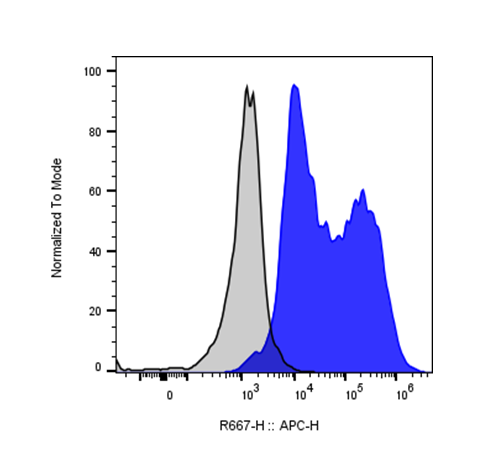
CD69 (also known as CLEC2C, VEA, AIM, EA1, MLR3, gp34/28) is a type II transmembrane C-type lectin glycoprotein that forms a ~60 kDa disulfide-linked homodimer. The mature human protein consists of a 40-amino-acid cytoplasmic domain, a 21-amino-acid transmembrane segment, and a 138-amino-acid extracellular domain containing a C-type lectin domain, sharing ~57% sequence identity with mouse and rat CD69. CD69 is rapidly upregulated on activated immune cells, including CD4⁺ and CD8⁺ T cells, NK cells, NKT cells, γδ T cells, B cells, dendritic cells, neutrophils, and a subset of thymocytes and platelets. It functions as an early activation marker, mediates T cell differentiation, immune cell trafficking, and homing of CD4⁺ T cells and plasmablasts to bone marrow, while inhibiting migration of dermal dendritic cells to lymph nodes.
APC Mouse IgG1 Isotype Control
Have a product or application question? Consult our FAQs or contact us.