| Cat # | Size | Price | Quantity | |
|---|---|---|---|---|
| 805103 | 25 ug | $245 | ||
| 805104 | 100 ug | $595 |
| Application | ELISA, BLI |
|---|---|
| Format | Liquid, Biotinylated |
| Expression Host | CHO |
| Target Name | CD171, L1CAM |
| Species | Human |
| Sources | Recombinant Human CD171/L1CAM protein (Ile20-Glu1120) with C-terminus His-Avi tag is expressed in CHO cells. This protein was site-specifically labeled with Biotin by BirA ligase. |
| Accession Number | P32004 |
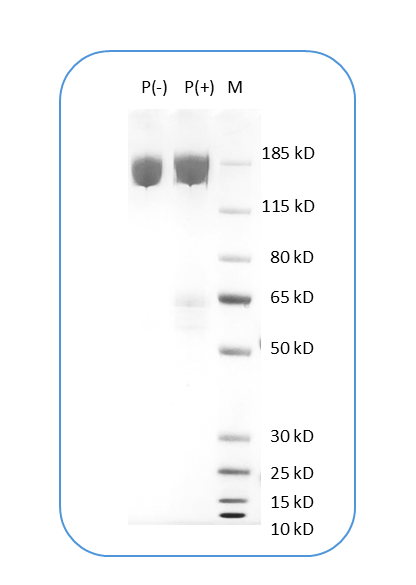
| Molecular Weight | The protein has a predicted molecular weight of 126.7 kDa. Under DTT-reducing conditions, it migrates at approximately 160-200 kDa on SDS-PAGE. |
| Affinity Tag | C-His-Avi |
| Purity | >95% based on SDS-PAGE under reducing condition |
| Regulatory Status | RUO |
| Formulation | 1xPBS buffer, pH7.4, 0.22 µm filtered |
| Endotoxin level | Not tested |
| Protein Concentration | 25µg size is bottled at 0.2mg/mL concentration. 100 µg size is supplied at a lot-specific concentration. |
| Storage and Handling | Briefly centrifuge the vial upon receipt. An unopened vial can be stored at 4°C for up to 2 weeks, or at -20°C or below for up to six months. The protein may be further diluted to 0.1 mg/mL using 0.22 µm-filtered PBS buffer (pH 7.4). For long-term storage, the diluted stock solution should be aliquoted and stored at ≤ –70°C to minimize freeze-thaw cycles. If additional dilution is required, carrier proteins such as FBS or BSA should be added to maintain protein stability. |
CD171, also known as L1CAM or L1, is a 200–220 kD transmembrane glycoprotein and a member of the immunoglobulin superfamily, originally identified for its essential role in nervous system development. It mediates neuron-neuron adhesion, axon guidance, signal transduction, cell migration, and differentiation. Although initially thought to be restricted to neural tissue, L1CAM has since been detected in various non-neural tissues and numerous cancer types. Its expression in tumors is associated with increased cell motility, proliferation, treatment resistance, and poor prognosis, making it a promising target for anti-cancer therapy. Mutations in the L1CAM gene are responsible for the CRASH spectrum of X-linked neurological disorders, including corpus callosum hypoplasia, mental retardation, aphasia, spastic paraplegia, and hydrocephalus. L1CAM interacts with several ligands such as integrins, axonin-1, CD9, and neurocan, with the RGD motif in its sixth Ig domain playing a key role in integrin binding and intracellular signaling.
Biotinylated Human CD171/L1CAM Protein (C-His-Avi) TDS
Have a product or application question? Consult our FAQs or contact us.