| Cat # | Size | Price | Quantity | |
|---|---|---|---|---|
| 801903 | 25 ug | $245 | ||
| 801904 | 100 ug | $595 |
| Application | ELISA, BLI |
|---|---|
| Format | Liquid, Biotinylated |
| Expression Host | CHO |
| Target Name | CD22, SIGLEC2, BL-CAM |
| Species | Human |
| Sources | Human CD22 protein (Asp20-Arg687) with C-terminus Fc-Avi tag is expressed in CHO cells. This protein was site-specifically labeled with Biotin by BirA ligase. |
| Accession Number | P20273 |
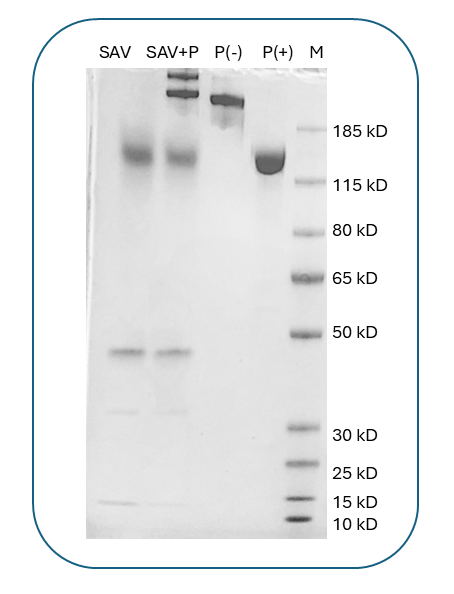
| Molecular Weight | The protein has a predicted molecular weight of 103 kDa. Under DTT-reducing conditions, it migrates at approximately 130-150 kDa on SDS-PAGE. |
| Affinity Tag | C-Fc-Avi |
| Purity | >95% based on SDS-PAGE under reducing condition |
| Regulatory Status | RUO |
| Formulation | 1xPBS buffer, pH7.4, 0.22 µm filtered |
| Endotoxin level | Not tested |
| Protein Concentration | 25µg size is bottled at 0.2mg/mL concentration. 100 µg size is supplied at a lot-specific concentration. |
| Storage and Handling | Briefly centrifuge the vial upon receipt. An unopened vial can be stored at 4°C for up to 2 weeks, or at -20°C or below for up to six months. The protein may be further diluted to 0.1 mg/mL using 0.22 µm-filtered PBS buffer (pH 7.4). For long-term storage, the diluted stock solution should be aliquoted and stored at ≤ –70°C to minimize freeze-thaw cycles. If additional dilution is required, carrier proteins such as FBS or BSA should be added to maintain protein stability. |
CD22, also known as Siglec-2 or BL-CAM, is a 130 kDa type I transmembrane glycoprotein and a member of the immunoglobulin superfamily and SIGLEC family. It is expressed in the cytoplasm of pro-B and pre-B cells and on the surface of mature and activated B cells, but not plasma cells. CD22 acts as both an adhesion receptor that binds α2,6-linked sialic acid-containing glycoproteins (such as CD45RO and CD75) and a key modulator of B cell receptor (BCR) signaling. Through its immunoreceptor tyrosine-based inhibitory motifs (ITIMs), CD22 recruits SHP-1 phosphatase to attenuate BCR-mediated calcium signaling, helping to establish B cell activation thresholds and maintain immune tolerance. CD22 also interacts with signaling molecules including Lyn, Syk, Lck, and PLCγ1, and its function is partly regulated by CD19 and ligand binding. It is involved in B cell–B cell interactions and may play a role in B cell localization within lymphoid tissues.
Biotinylated Human CD22 Protein (C-Fc-Avi) TDS
Have a product or application question? Consult our FAQs or contact us.