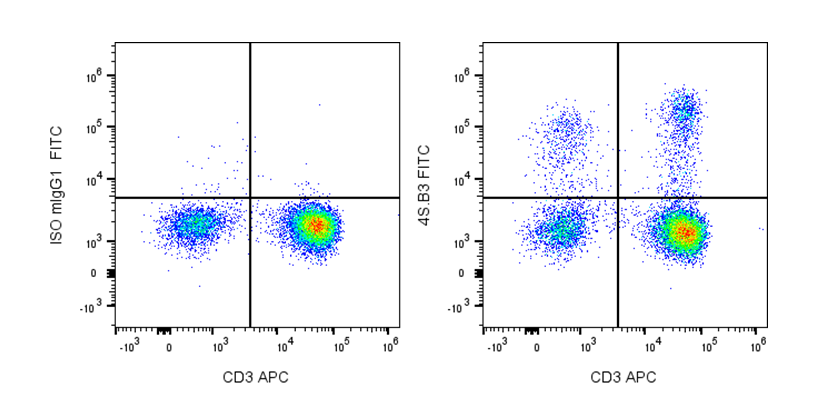
| Cat # | Size | Price | Quantity | |
|---|---|---|---|---|
| 110606 | 25 tests | $85 | ||
| 110607 | 100 tests | $185 |
| Clone | 4S.B3 |
|---|---|
| Application | FC |
| Reactivity | Human |
| Format | FITC |
| Target Name | IFNg, IFN-g, IFN-gamma, Interferon-γ |
| Isotype | Mouse IgG1 |
| Antibody Type | Monoclonal |
| Regulatory Status | RUO |
| Formulation | Phosphate-buffered solution, pH 7.2, containing 0.09% sodium azide and 0.2% (w/v) BSA |
| Protein Concentration | Supplied at a lot-specific concentration. |
| Storage&Handling | The antibody solution should be stored undiluted between 2°C and 8°C, and protected from prolonged exposure to light. Do not freeze. |
| Recommended Usage | For flow cytometric staining, it is recommended to use 5 uL of this reagent per 0.5-1.0 million cells in a 100 µL volume. Optimal reagent performance should be determined by titration for each specific application. |
| Excitation Laser | Blue Laser (488 nm) |
Human Interferon gamma (hIFN-γ) is the sole member of Type II interferons and a potent macrophage-activating cytokine produced mainly by activated T lymphocytes and natural killer (NK) cells. Structurally, it is an antiparallel homodimeric glycoprotein of approximately 45 kDa, consisting of two identical 146-amino-acid subunits. Binding of hIFN-γ to its receptor (IFN-γR1) activates the JAK/STAT signaling pathway, leading to the transcription of genes involved in antiviral, antibacterial, and immunoregulatory responses. Functionally, hIFN-γ upregulates MHC class I and II expression, enhances antigen presentation, and promotes Th1-type immune responses. It recruits and activates macrophages, NK cells, and cytotoxic T lymphocytes (CTLs), reinforcing innate and adaptive immunity. Although crucial for host defense, IFN-γ can also contribute to immune escape and tumor resistance in certain cancers.
FITC Mouse IgG1 Isotype Control
Have a product or application question? Consult our FAQs or contact us.