| Cat # | Size | Price | Quantity | |
|---|---|---|---|---|
| 606501 | 25 ug | $145 | ||
| 606502 | 100 ug | $295 |
| Application | ELISA, BLI |
|---|---|
| Format | Liquid, Purified |
| Expression Host | CHO |
| Target Name | TNFSF18, GITR Ligand, AITRL, TL6, GITRL |
| Species | Human |
| Accession Number | Q9UNG2 |
| Sources | Recombinant Human TNFSF18 (Glu52-Ser177) with N-terminus His tag is expressed in CHO cells. |
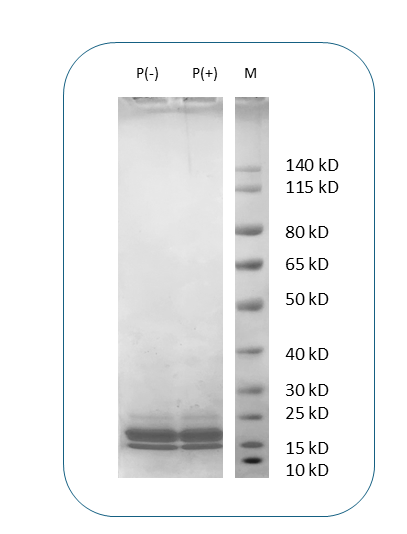
| Molecular Weight | This prtoein has the predicted molecular weight of 15.8 kD. Under DTT-reducing conditions, the protein migrates at approximately 20 kD on SDS-PAGE |
| Affinity Tag | N-His |
| Purity | >90% based on SDS-PAGE under reducing condition |
| Regulatory Status | RUO |
| Formulation | 1xPBS buffer, pH7.4, 0.22 µm filtered |
| Endotoxin level | Less than 0.1 EU/µg protein as determined by the LAL method |
| Protein Concentration | 25µg size is bottled at 0.2mg/mL concentration. 100 µg size is supplied at a lot-specific concentration. |
| Storage and Handling | Briefly centrifuge the vial upon receipt. An unopened vial can be stored at 4°C for up to 2 weeks, or at -20°C or below for up to six months. The protein may be further diluted to 0.1 mg/mL using 0.22 µm-filtered PBS buffer (pH 7.4). For long-term storage, the diluted stock solution should be aliquoted and stored at ≤ –70°C to minimize freeze-thaw cycles. If additional dilution is required, carrier proteins such as FBS or BSA should be added to maintain protein stability. |
Human GITRL (Glucocorticoid-Induced TNFR-Related Ligand), also known as TNFSF18, is a member of the tumor necrosis factor (TNF) superfamily. It is a type II transmembrane protein primarily expressed on activated antigen-presenting cells, including B cells, dendritic cells, and macrophages. GITRL binds to its receptor GITR, which is found on activated T cells, regulatory T cells (Tregs), and natural killer (NK) cells. The GITR–GITRL interaction delivers a co-stimulatory signal that promotes T cell activation, proliferation, and survival, while also modulating the suppressive activity of Tregs. This signaling pathway plays a key role in immune regulation, inflammation, and antitumor immunity.
Human GITRL/TNFSF18 (N-His) TDS
Have a product or application question? Consult our FAQs or contact us.