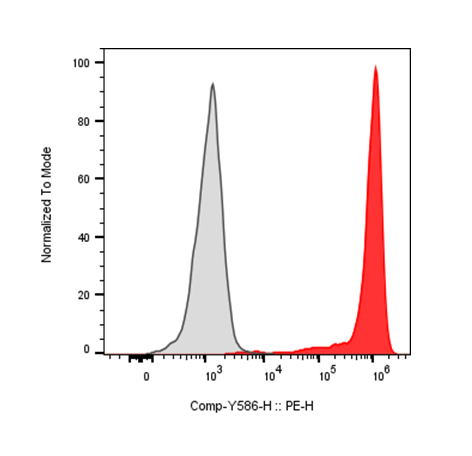
| Cat # | Size | Price | Quantity | |
|---|---|---|---|---|
| 110105 | 25 tests | $50 | ||
| 110106 | 100 tests | $110 |
| Clone | M5E2 |
|---|---|
| Application | FC |
| Reactivity | Human |
| Format | PE |
| Target Name | CD14, LPS receptor |
| Isotype | Mouse IgG2a |
| Antibody Type | Monoclonal |
| Regulatory Status | RUO |
| Formulation | Phosphate-buffered solution, pH 7.2, containing 0.09% sodium azide and 0.2% (w/v) BSA |
| Protein Concentration | Supplied at a lot-specific concentration. |
| Storage&Handling | The antibody solution should be stored undiluted between 2°C and 8°C, and protected from prolonged exposure to light. Do not freeze. |
| Recommended Usage | For flow cytometric staining, it is recommended to use 5 uL of this reagent per 0.5-1.0 million cells in a 100 µL volume. Optimal reagent performance should be determined by titration for each specific application. |
| Excitation Laser | Blue Laser (488 nm) Green/Yellow laser (532/561nm) |
CD14 is a pattern recognition receptor critical for innate immunity. It exists as a glycosylphosphatidylinositol (GPI)-anchored membrane protein (mCD14) on monocytes, macrophages, and neutrophils, and as a soluble protein (sCD14) in the blood, generated via enzymatic cleavage or shedding. Membrane CD14 acts as a pro-inflammatory co-receptor for lipopolysaccharide (LPS), interacting with LPS-binding protein (LBP) and TLR4 to activate NF-κB and MAPK signaling, driving inflammatory responses. Soluble CD14 enables LPS responsiveness in cells lacking CD14, such as endothelial cells. CD14 expression is modulated by stimuli including LPS, IFNγ, PMA, calcium ionophore, and anti-CD14 antibodies. Elevated sCD14 levels are observed in conditions such as sepsis, systemic lupus erythematosus, HIV infection, common variable immunodeficiency (CVID), nonalcoholic fatty liver disease (NAFLD), and breast invasive ductal carcinoma, highlighting its potential as a biomarker for infection, inflammation, and disease prognosis.
PE Mouse IgG2a Isotype Control
Have a product or application question? Consult our FAQs or contact us.