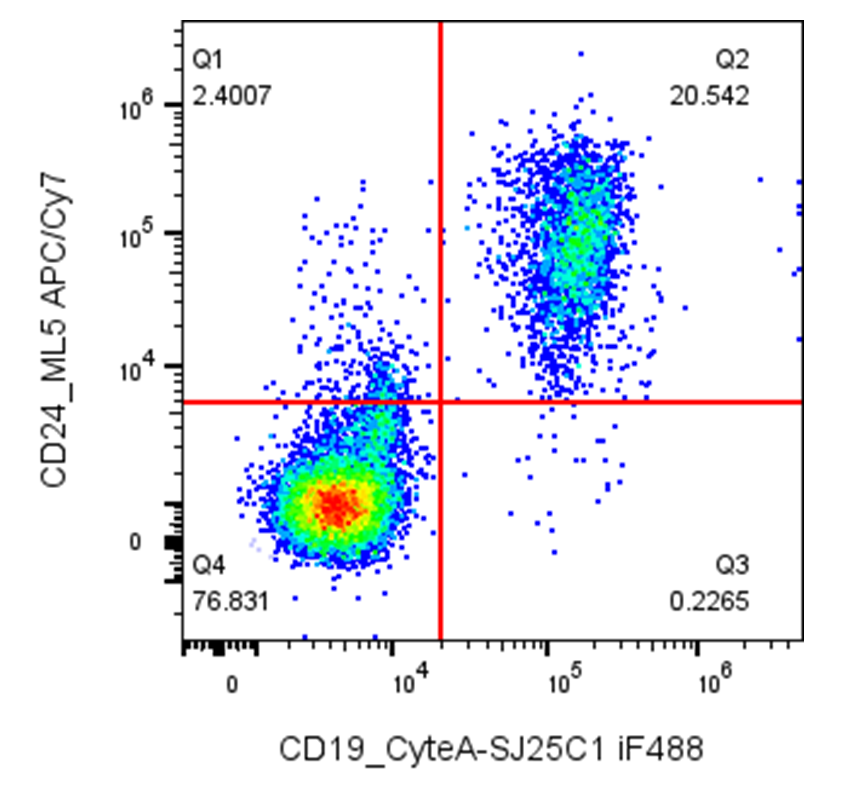
| Cat # | Size | Price | Quantity | |
|---|---|---|---|---|
| 118411 | 25 tests | $135 | ||
| 118412 | 100 tests | $310 |
| Clone | ML5 |
|---|---|
| Application | Flow Cytometry |
| Reactivity | Human |
| Format | APC/Cyanine7 |
| Target Name | CD24, Ly-52, CD24 molecule; CD24A, heat-stable antigen (HSA) |
| Isotype | Mouse IgG2a |
| Antibody Type | Monoclonal |
| Regulatory Status | RUO |
| Formulation | Phosphate-buffered solution, pH 7.2, containing 0.09% sodium azide and 0.2% (w/v) BSA |
| Protein Concentration | Supplied at a lot-specific concentration. |
| Storage&Handling | The antibody solution should be stored undiluted between 2°C and 8°C, and protected from prolonged exposure to light. Do not freeze. |
| Recommended Usage | For flow cytometric staining, it is recommended to use 5 µL of this reagent per 0.5-1.0 million cells in a 100 µL volume. Optimal reagent performance should be determined by titration for each specific application. APC/Cyanine7 has an excitation max at 650 nm and an emission max at 774 nm. |
| Excitation Laser | Red Laser (633 nm) |
| Isotype Controls | 301518 |
| Antibody Family | Human Antibodies |
| Storage & Handling | The antibody solution should be stored undiluted between 2°C and 8°C, and protected from prolonged exposure to light. Do not freeze. |
| See All Formats | Clone ML5 |
Human CD24, also known as cluster of differentiation 24 or heat-stable antigen (HSA), is a small, highly glycosylated cell-surface protein involved in immune regulation, cell adhesion, and cellular signaling. It is expressed on various cell types, including B lymphocytes, granulocytes, monocytes, epithelial cells, and neural cells. CD24 contributes to immune cell activation and differentiation, regulates inflammatory responses, and participates in interactions between immune cells and their surrounding environment.
CD24 is encoded by the CD24 gene on chromosome 6q21. Its mature protein backbone consists of approximately 31–34 amino acids and is extensively modified by N-linked and O-linked glycosylation. These carbohydrate modifications contribute substantially to its molecular mass, typically approximately 35–45 kDa. Unlike conventional transmembrane proteins, CD24 lacks an intracellular signaling domain and is attached to the outer surface of the plasma membrane through a glycosylphosphatidylinositol (GPI) anchor. Its biological activity is largely mediated through interactions with other cell-surface molecules. Important binding partners include Siglec-10, P-selectin, and L1 cell adhesion molecule (L1CAM).
CD24 plays important roles in inflammatory regulation and cancer development. Its interaction with Siglec-10 on macrophages delivers an inhibitory signal that suppresses macrophage-mediated phagocytosis and helps protect cells from excessive inflammatory responses. However, many solid tumors, including breast, ovarian, lung, and colorectal cancers, overexpress CD24, exploiting this pathway as a "don't eat me" signal to evade immune surveillance. Elevated CD24 expression has also been associated with tumor progression, metastasis, and cancer stem-cell characteristics.
Therapeutically, CD24 represents a promising target for cancer immunotherapy. Blocking CD24–Siglec-10 interactions using monoclonal antibodies may enhance macrophage-mediated tumor clearance. Other investigational approaches include antibody–drug conjugates and CD24-directed CAR T-cell therapies. Modulating the CD24–Siglec pathway may also have potential in inflammatory and autoimmune diseases, although further clinical research is needed to establish its safety and effectiveness.
APC/Cyanine7 Mouse IgG2a Isotype Control Antibody
APC/Cyanine7 Anti-Human CD24 Antibody TDS
Have a product or application question? Consult our FAQs or contact us.