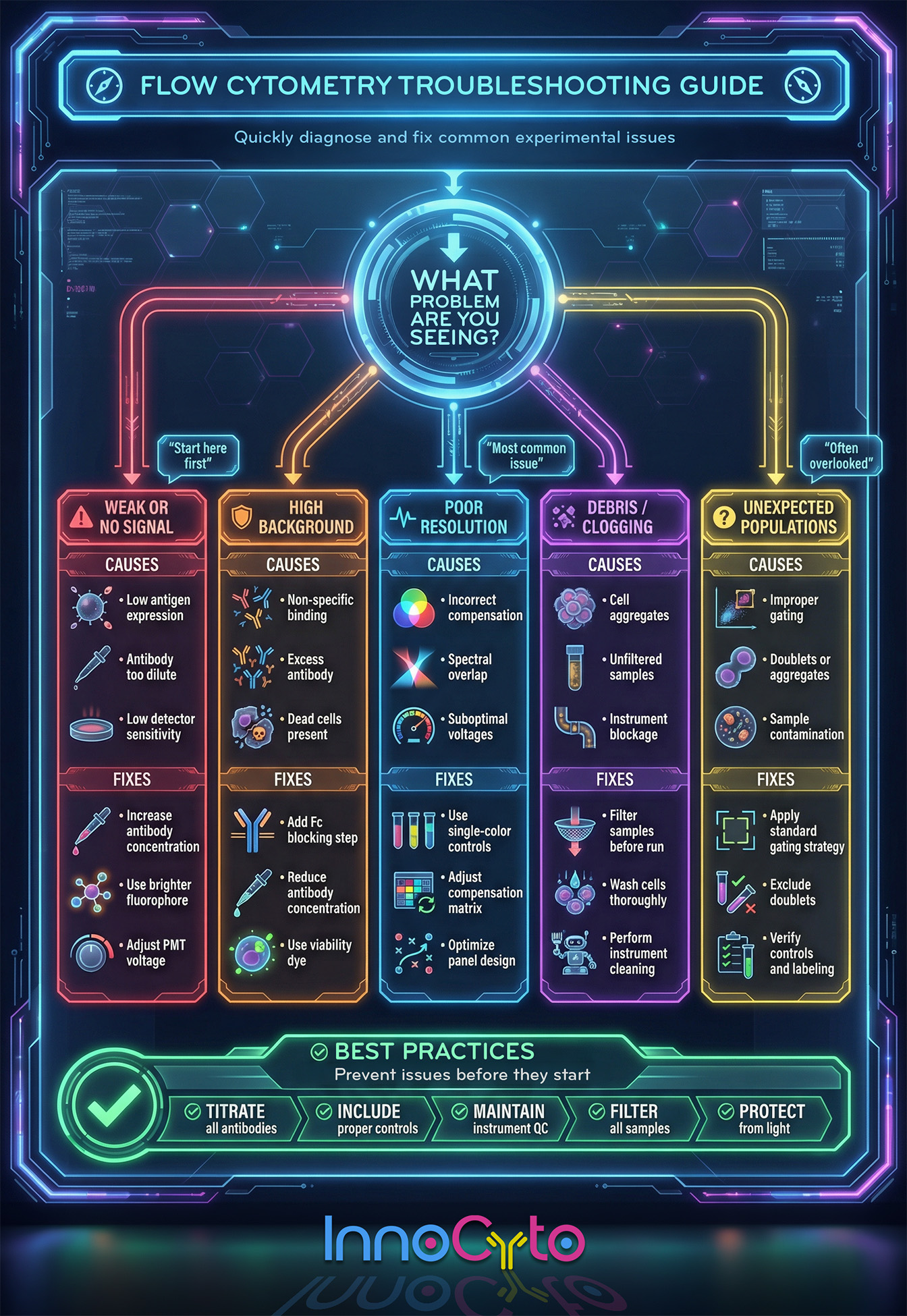
This infographic is designed as a quick-reference guide to help you diagnose and resolve common issues in conventional flow cytometry experiments. It walks you through five of the most frequent challenges: weak or no signal, high background, poor resolution, debris or clogging, and unexpected populations.
Each section breaks the problem down into likely causes and practical fixes, making it easy to pinpoint what’s going wrong and how to correct it. Whether the issue stems from antibody concentration, non-specific binding, compensation errors, sample quality, or instrument performance, the guide provides clear, actionable steps to get your experiment back on track.
At the bottom, a set of core best practices reinforces the fundamentals of good flow cytometry: antibody titration, proper controls, routine instrument QC, sample filtration, and light protection. Together, these serve as a foundation for preventing issues before they arise and ensuring consistent, high-quality data.
Use this guide as a bench-side companion or a quick diagnostic tool to improve efficiency, reproducibility, and confidence in your flow cytometry workflows.
Contact an expert for more detailed support.