| Cat # | Size | Price | Quantity | |
|---|---|---|---|---|
| 121203 | 25 tests | $145 | ||
| 121204 | 100 tests | $320 |
| Clone | 159aAB |
|---|---|
| Application | Flow Cytometry |
| Reactivity | Human |
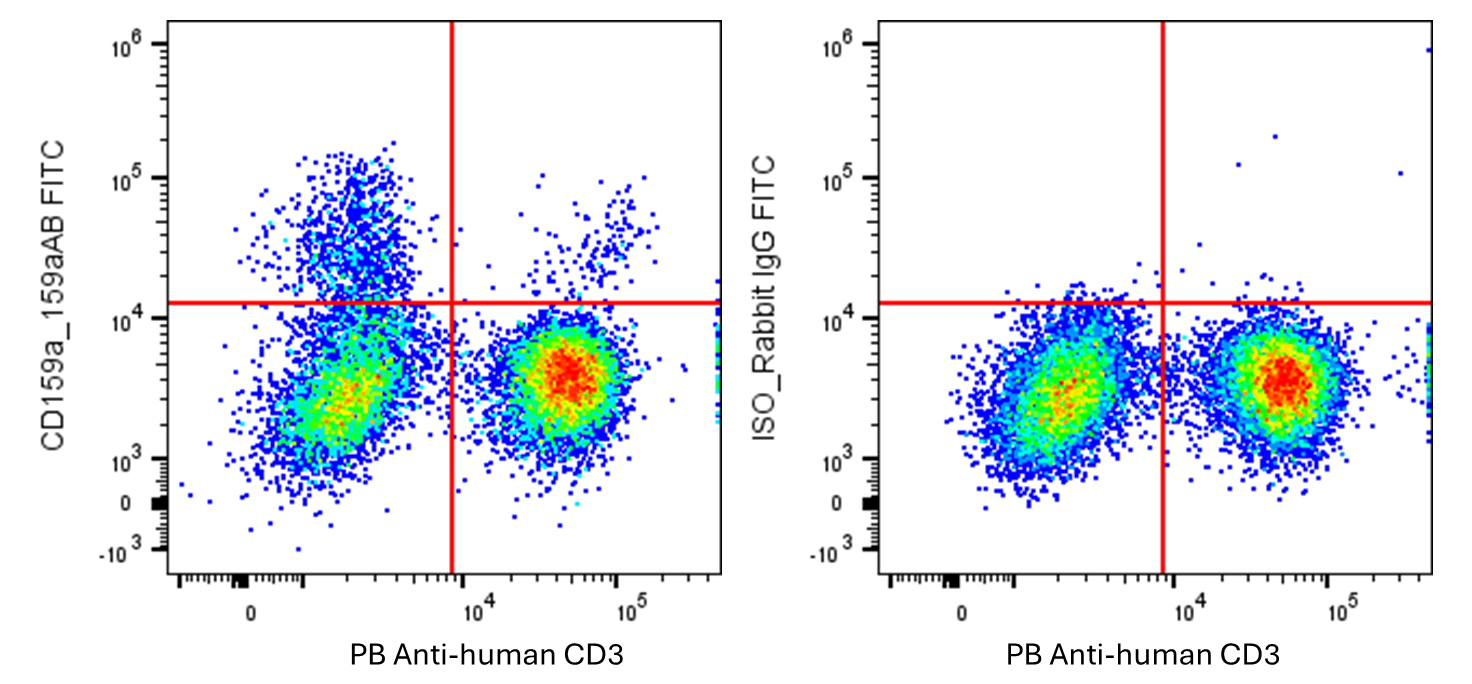
| Format | FITC |
| Target Name | CD159a, NKG2A, NK Cell Receptor A, Killer Cell Lectin Like Receptor C1, KLRC1 |
| Isotype | Rabbit IgG |
| Antibody Type | Monoclonal |
| Regulatory Status | RUO |
| Formulation | Phosphate-buffered solution, pH 7.2, containing 0.09% sodium azide and 0.2% (w/v) BSA |
| Protein Concentration | Supplied at a lot-specific concentration. |
| Storage&Handling | The antibody solution should be stored undiluted between 2°C and 8°C, and protected from prolonged exposure to light. Do not freeze. |
| Recommended Usage | For flow cytometric staining, it is recommended to use 5 µL of this reagent per 0.5-1.0 million cells in a 100 µL volume. Optimal reagent performance should be determined by titration for each specific application. FITC has an excitation max at 493 nm and an emission max at 525 nm. |
| Excitation Laser | Blue Laser (488 nm) |
| Isotype Controls | 303309 |
| Antibody Family | Human Antibodies |
| Storage & Handling | The antibody solution should be stored undiluted between 2°C and 8°C, and protected from prolonged exposure to light. Do not freeze. |
| See All Formats | Clone 159aAB |
Human CD159a, also known as NKG2A or natural killer cell receptor A, is an inhibitory immune checkpoint receptor encoded by the KLRC1 gene on chromosome 12. It is primarily expressed on natural killer (NK) cells and is also found on subsets of natural killer T (NKT) cells and cytotoxic T lymphocytes, particularly CD8+ T cells. CD159a plays an important role in immune surveillance by regulating cytotoxic lymphocyte activity and preventing excessive immune responses against healthy cells.
CD159a is a type II transmembrane glycoprotein belonging to the C-type lectin-like receptor family. Its structure consists of a short cytoplasmic region, a transmembrane segment, and an extracellular C-type lectin-like domain responsible for receptor association and ligand recognition. CD159a does not function independently but forms a disulfide-linked heterodimer with CD94 (NKG2A/CD94) on the cell surface. Its principal ligand is human leukocyte antigen E (HLA-E), a non-classical MHC class I molecule that presents peptides, commonly derived from the signal sequences of classical HLA class I proteins. The corresponding ligand in mice is Qa-1.
Upon binding to HLA-E, the CD94/NKG2A complex delivers inhibitory signals through immunoreceptor tyrosine-based inhibitory motifs (ITIMs) in the CD159a cytoplasmic domain. These motifs recruit phosphatases, including SHP-1 and SHP-2, suppressing intracellular activation pathways and reducing NK-cell and T-cell cytotoxicity. Although this mechanism helps maintain immune tolerance, many tumors increase HLA-E expression to exploit this pathway and evade immune surveillance. Increased NKG2A expression on tumor-infiltrating lymphocytes has also been associated with impaired antitumor immune activity.
Therapeutically, CD159a is an attractive target for cancer immunotherapy. Blocking the NKG2A–HLA-E interaction with monoclonal antibodies may restore NK-cell and CD8+ T-cell function and enhance tumor-cell killing. Combining NKG2A blockade with PD-1/PD-L1 inhibitors or other immunotherapies may further improve antitumor responses. This pathway is also being investigated in the development of more effective NK-cell-based and T-cell-based cancer treatments.
FITC Rabbit IgG, κ2 Isotype Control Antibody
FITC Anti-human CD159a (NKG2A) Antibody TDS
Have a product or application question? Consult our FAQs or contact us.