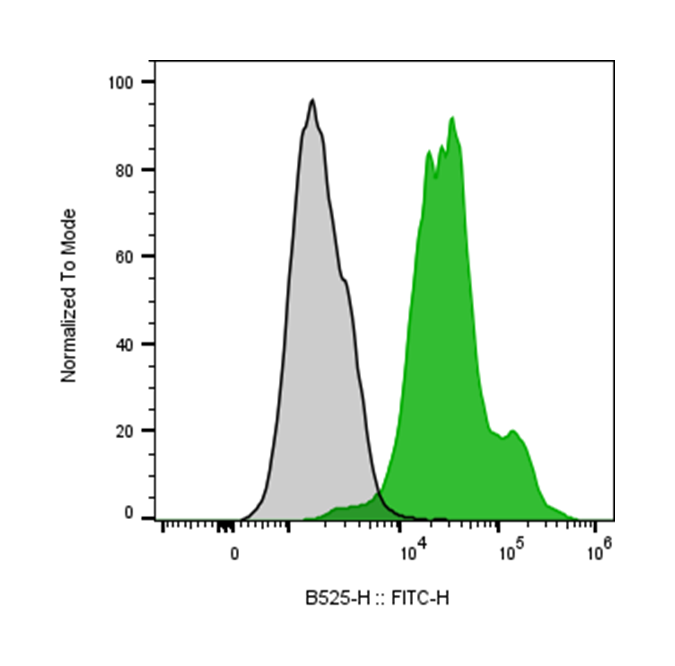
| Cat # | Size | Price | Quantity | |
|---|---|---|---|---|
| 203505 | 25 tests | $80 | ||
| 203506 | 100 tests | $180 |
| Clone | R1-2 |
|---|---|
| Application | Flow Cytometry |
| Reactivity | Mouse |
| Format | iF488 |
| Target Name | CD49d, ITGA4, integrin alpha 4 |
| Isotype | Rat IgG2b |
| Antibody Type | Monoclonal |
| Regulatory Status | RUO |
| Formulation | Phosphate-buffered solution, pH 7.2, containing 0.09% sodium azide and 0.2% (w/v) BSA |
| Protein Concentration | Supplied at a lot-specific concentration. |
| Storage&Handling | The antibody solution should be stored undiluted between 2°C and 8°C, and protected from prolonged exposure to light. Do not freeze. |
| Recommended Usage | For flow cytometric staining, it is recommended to use 5 µL of this reagent per 0.5-1.0 million cells in a 100 µL volume. Optimal reagent performance should be determined by titration for each specific application. iF488 has an excitation max at 491 nm and an emission max at 516 nm. |
| Excitation Laser | Blue Laser (488 nm) |
| Research Areas | Adhesion Molecules, T cells, B cells, NK cells, Monocytes, Inflammation |
| See All Formats | Clone R1-2 |
Mouse CD49d, also known as integrin α4, is a cell surface adhesion molecule that belongs to the integrin family of heterodimeric receptors involved in cell adhesion, migration, and immune cell trafficking. CD49d pairs with the β1 integrin subunit (CD29) to form α4β1 integrin, also known as very late antigen-4 (VLA-4), and can also associate with β7 integrin to form α4β7. These integrin complexes are expressed on several leukocyte populations, including lymphocytes, monocytes, eosinophils, and some progenitor cells, where they regulate cell movement and interactions with the vascular endothelium and extracellular matrix.
Structurally, CD49d is a large transmembrane glycoprotein of approximately 150 kDa. It contains an extracellular domain responsible for ligand recognition, a single transmembrane segment, and a short cytoplasmic tail that interacts with intracellular adaptor proteins. Like other integrins, α4-containing integrins undergo conformational changes that regulate their affinity for ligands, allowing immune cells to switch between low-adhesion and high-adhesion states in response to activation signals.
The principal ligands for CD49d-containing integrins include vascular cell adhesion molecule-1 (VCAM-1) and the extracellular matrix protein fibronectin. Through these interactions, CD49d mediates leukocyte adhesion to endothelial cells and facilitates the migration of immune cells from the bloodstream into inflamed tissues.
CD49d plays important roles in inflammatory diseases, autoimmune disorders, and cancer by promoting immune cell infiltration and retention within tissues. Because of this function, the α4 integrin pathway has been targeted therapeutically to limit pathological immune cell migration. Antibodies or inhibitors that block α4 integrins can reduce inflammatory cell recruitment, and this strategy has been successfully applied in treatments for certain autoimmune diseases. In experimental mouse models, CD49d antibodies are widely used to study leukocyte trafficking, hematopoiesis, and immune responses.
iF488 Rat IgG2b Isotype Control
iF488 Anti-Mouse CD49d Antibody TDS
PE Anti-Mouse/Human CD11b (Integrin αM) Antibody, Clone M1/70
FITC Anti-Mouse CD11c (integrin αX) Antibody, Clone N418
In Vivo Star Anti-Mouse CD11c (integrin αX) Antibody, Clone N418-mg1
Have a product or application question? Consult our FAQs or contact us.