| Cat # | Size | Price | Quantity | |
|---|---|---|---|---|
| 204203 | 25 tests | $80 | ||
| 204204 | 100 tests | $200 |
| Clone | 2F1 |
|---|---|
| Application | Flow Cytometry |
| Reactivity | Mouse, Human |
| Format | iF488 |
| Target Name | KLRG1, MAFA, 2F1-Ag |
| Isotype | Syrian Hamster IgG |
| Antibody Type | Monoclonal |
| Regulatory Status | RUO |
| Formulation | Phosphate-buffered solution, pH 7.2, containing 0.09% sodium azide and 0.2% (w/v) BSA |
| Protein Concentration | Supplied at a lot-specific concentration. |
| Storage&Handling | The antibody solution should be stored undiluted between 2°C and 8°C, and protected from prolonged exposure to light. Do not freeze. |
| Recommended Usage | For flow cytometric staining, it is recommended to use 5 µL of this reagent per 0.5-1.0 million cells in a 100 µL volume. Optimal reagent performance should be determined by titration for each specific application. iF488 has an excitation max at 491 nm and an emission max at 516 nm. |
| Excitation Laser | Blue Laser (488 nm) |
| Research Areas | Immune Checkpoints, NK cells, T cells, Tregs, Cancer Immunology, Infectious Diseases |
| See All Formats | Clone 2F1 |
KLRG1 (Killer Cell Lectin-Like Receptor Subfamily G Member 1) is an inhibitory receptor expressed on several immune cell populations, particularly natural killer (NK) cells and subsets of T lymphocytes. It is commonly used as a marker of terminal differentiation or functional maturation in effector CD8+ T cells and NK cells. KLRG1 plays an important role in regulating immune responses by delivering inhibitory signals that limit excessive activation, thereby helping maintain immune homeostasis during infections and inflammatory responses.
Structurally, KLRG1 is a type II transmembrane glycoprotein belonging to the C-type lectin-like receptor family. The protein contains a short N-terminal cytoplasmic domain, a single transmembrane region, and an extracellular C-type lectin-like domain responsible for ligand binding. Unlike classical C-type lectins, KLRG1 does not bind carbohydrates but instead recognizes protein ligands. The cytoplasmic tail contains an immunoreceptor tyrosine-based inhibitory motif (ITIM). When the receptor engages its ligand, this ITIM becomes phosphorylated and recruits phosphatases such as SHP-1 or SHP-2, which suppress downstream signaling pathways involved in cellular activation.
The primary ligands for KLRG1 are members of the classical cadherin family, including E-cadherin, N-cadherin, and R-cadherin. These molecules are widely expressed on epithelial cells and other tissue types. Interaction between KLRG1 on immune cells and cadherins on target cells transmits inhibitory signals that dampen cytotoxic activity and cytokine production. This interaction is thought to help prevent excessive immune-mediated tissue damage, particularly at epithelial surfaces where cadherins are abundant.
KLRG1 has been studied extensively in the context of infections, aging, and cancer. During viral or bacterial infections, a population of KLRG1high CD8+ T cells often emerges; these cells represent short-lived effector cells that exhibit strong cytotoxic activity but limited proliferative capacity. In chronic infections and aging, increased frequencies of KLRG1-expressing T cells are associated with immune senescence and reduced immune responsiveness. In cancer, KLRG1-mediated inhibitory signaling may contribute to reduced anti-tumor activity of NK and T cells within the tumor microenvironment.
Because of its role as an immune inhibitory receptor, KLRG1 has attracted interest as a potential target for immunotherapy. Blocking KLRG1 interactions with cadherins could enhance the cytotoxic function of NK cells and CD8+ T cells, thereby improving anti-tumor immune responses. Conversely, enhancing KLRG1 signaling might be beneficial in conditions where immune responses need to be restrained, such as autoimmune or inflammatory diseases. In addition, KLRG1 expression is widely used as a biomarker in immunological research to identify differentiated effector T cells and to track immune responses in infection and vaccination models.
iF647 Syrian Hamster IgG Isotype Ctrl (Fc silent) Antibody
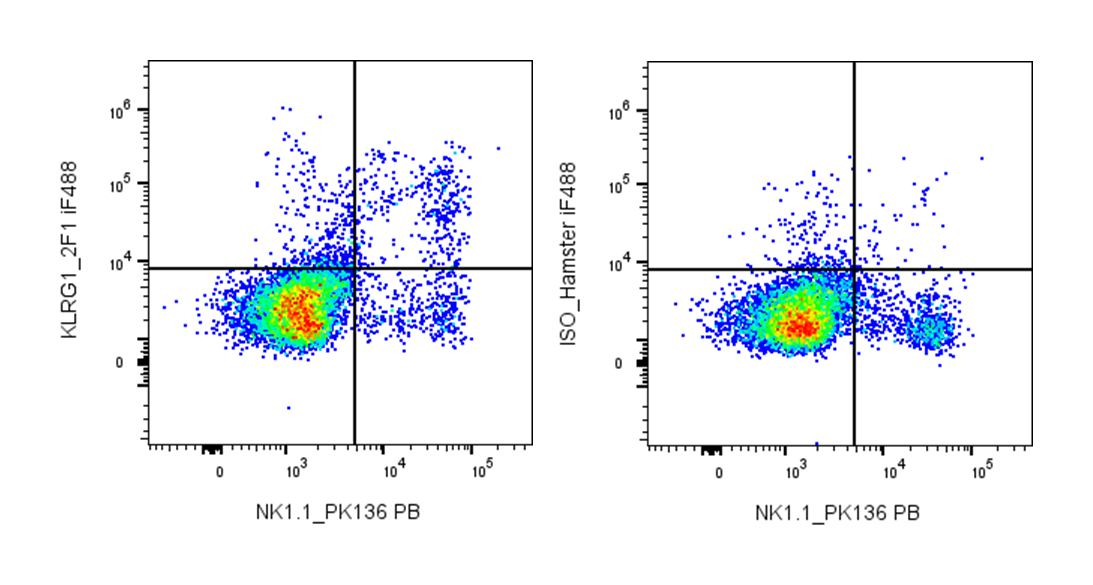
iF488 Anti-mouse/human KLRG1 (MAFA) Antibody TDS
iF647 Anti-Mouse CD49b (pan-NK, integrin α2) Antibody, Clone DX5
iF700 Anti-Mouse NK-1.1 Antibody, Clone PK136
In Vivo Star Anti-Mouse NK1.1 Antibody, Clone PK136
Have a product or application question? Consult our FAQs or contact us.