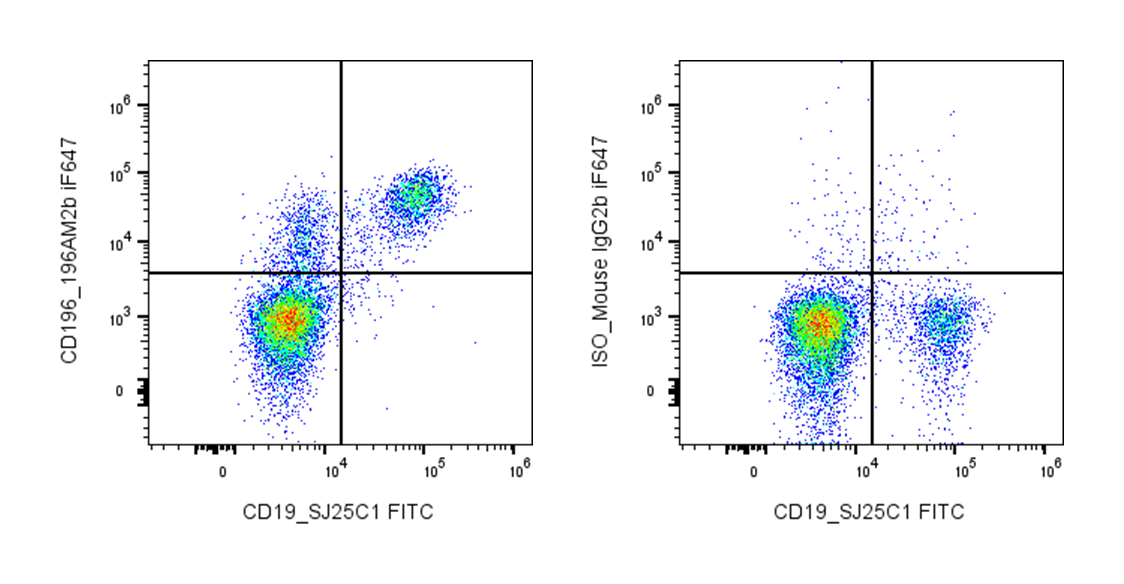
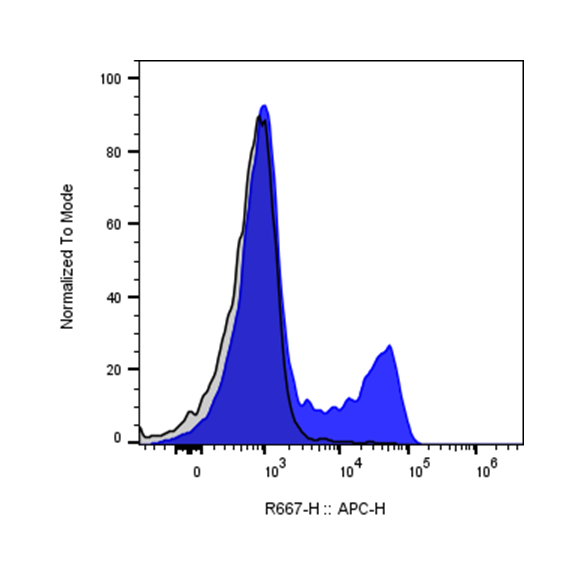
| Cat # | Size | Price | Quantity | |
|---|---|---|---|---|
| 112003 | 25 tests | $105 | ||
| 112004 | 100 tests | $240 |
| Clone | 196AM2b |
|---|---|
| Application | Flow Cytometry |
| Reactivity | Human |
| Format | iF647 |
| Target Name | CD196, CCR6, DRY-6, STRL22,CKR-L3 |
| Isotype | Mouse IgG2b |
| Antibody Type | Monoclonal |
| Regulatory Status | RUO |
| Formulation | Phosphate-buffered solution, pH 7.2, containing 0.09% sodium azide and 0.2% (w/v) BSA |
| Protein Concentration | Supplied at a lot-specific concentration. |
| Storage&Handling | The antibody solution should be stored undiluted between 2°C and 8°C, and protected from prolonged exposure to light. Do not freeze. |
| Recommended Usage | For flow cytometric staining, it is recommended to use 5 µL of this reagent per 0.5-1.0 million cells in a 100 µL volume. Optimal reagent performance should be determined by titration for each specific application. iF647 has an excitation max at 656 nm and an emission max at 670 nm. |
| Excitation Laser | Red Laser (633 nm) |
| Research Areas | Chemokine receptors, Chemotaxis, B cells, Th17 cells, Dendritic cells |
| See All Formats | Clone 196AM2b |
CD196, also known as CCR6 (C-C chemokine receptor type 6), is a cell-surface chemokine receptor that plays an important role in immune cell trafficking and inflammatory responses. It belongs to the large family of G protein–coupled receptors (GPCRs) and is encoded by the CCR6 gene located on chromosome 6. The receptor is primarily expressed on several immune cell populations, including B lymphocytes, immature dendritic cells, and subsets of T cells such as memory T cells, Th17 cells, and regulatory T cells. Through its signaling functions, CD196 helps regulate immune cell migration and localization in tissues, particularly at mucosal and epithelial surfaces. :contentReference[oaicite:0]{index=0}
Structurally, CD196 is a membrane protein consisting of approximately 374 amino acids with a molecular weight of about 42 kDa. Like other GPCRs, it contains an extracellular N-terminal region, seven transmembrane α-helical domains, and a cytoplasmic C-terminal tail that interacts with intracellular signaling pathways. Activation of CD196 occurs when ligands bind to the extracellular portion of the receptor, triggering intracellular signaling cascades through associated G proteins and resulting in changes such as increased intracellular calcium levels and cell migration. :contentReference[oaicite:1]{index=1}
The principal ligand for CD196 is the chemokine CCL20, also known as macrophage inflammatory protein-3α (MIP-3α). The interaction between CCL20 and CD196 drives chemotaxis, guiding immune cells to specific tissues where immune responses are needed. In addition to CCL20, certain antimicrobial peptides from the β-defensin family can bind CD196 with lower affinity and trigger similar signaling effects. This receptor-ligand axis is particularly important in mucosal tissues such as the intestine and skin, where it helps recruit dendritic cells, B cells, and T cells to maintain immune surveillance and host defense. :contentReference[oaicite:2]{index=2}
CD196 has been implicated in several inflammatory and autoimmune diseases. For example, the CCL20–CCR6 signaling pathway contributes to the recruitment of Th17 cells, which produce the pro-inflammatory cytokine IL-17. Excessive accumulation of these cells is associated with diseases such as rheumatoid arthritis, psoriasis, and inflammatory bowel disease. Elevated CCR6 expression has also been observed in certain cancers and B-cell lymphomas, where it may influence tumor localization and immune interactions. :contentReference[oaicite:3]{index=3}
Because of its role in immune cell migration and inflammation, CD196 is considered a potential therapeutic target. Experimental strategies include small-molecule antagonists or antibodies that block CCR6 signaling to reduce inflammatory cell recruitment. Such approaches may help treat autoimmune disorders, chronic inflammatory diseases, and potentially certain cancers where the CCR6–CCL20 axis contributes to disease progression.
iF647 Mouse IgG2b Isotype Control Antibody
iF647 Anti-Human CD196 (CCR6) Antibody TDS
Anti-Human CD196 (CCR6) Antibody, Clone 196AM1
Have a product or application question? Consult our FAQs or contact us.