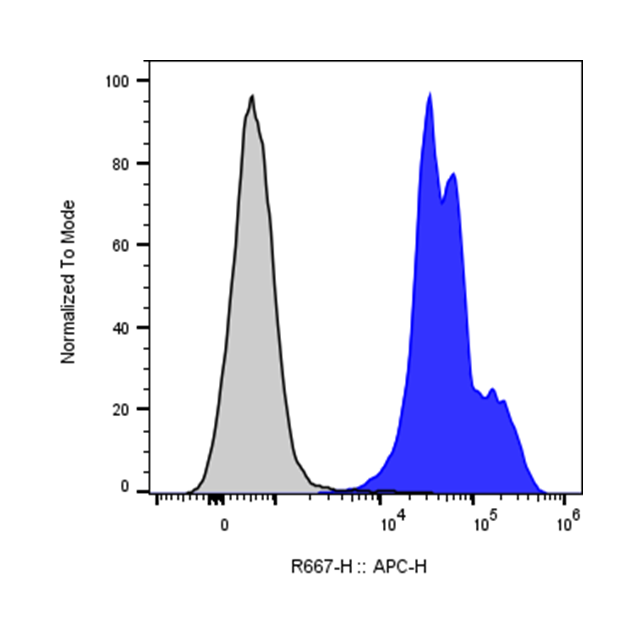
| Cat # | Size | Price | Quantity | |
|---|---|---|---|---|
| 203403 | 25 tests | $80 | ||
| 203404 | 100 tests | $180 |
| Clone | M17/4 |
|---|---|
| Application | Flow Cytometry |
| Reactivity | Mouse |
| Format | Purified |
| Target Name | CD11a, integrin alpha L (ITGAL), Ly-15, Ly-21, LFA-1 α subunit, |
| Isotype | Rat IgG2a |
| Antibody Type | Monoclonal |
| Regulatory Status | RUO |
| Formulation | Phosphate-buffered solution, pH 7.2, containing 0.09% sodium azide |
| Protein Concentration | Supplied at a lot-specific concentration. |
| Storage&Handling | The antibody solution should be stored undiluted between 2°C and 8°C, and protected from prolonged exposure to light. Do not freeze. |
| Recommended Usage | For flow cytometric staining, it is recommended to use 5 uL of this reagent per 0.5-1.0 million cells in a 100 µL volume. Optimal reagent performance should be determined by titration for each specific application. |
| Excitation Laser | Red Laser (633 nm) |
| Research Areas | Adhesion Molecules, Autoimmunity, Inflammation, T cells, B cells, Monocytes, Macrophages, Neutrophils, Basophils, Eosinophils |
| See All Formats | Clone M17/4 |
Mouse CD11a, also known as integrin αL, is a cell surface adhesion molecule that plays a critical role in immune cell interactions and migration. CD11a pairs with the β2 integrin subunit CD18 to form LFA-1 (lymphocyte function–associated antigen-1), a heterodimeric integrin expressed on most leukocytes, including T cells, B cells, natural killer cells, neutrophils, and monocytes. LFA-1 is essential for immune surveillance, enabling leukocytes to adhere to other cells and migrate into tissues during immune responses.
Structurally, CD11a is a large transmembrane glycoprotein of roughly 180 kDa that contains an extracellular ligand-binding domain, a single transmembrane region, and a short cytoplasmic tail. When associated with CD18, the heterodimer undergoes conformational changes that regulate its affinity for ligands. Like other integrins, LFA-1 can switch between low- and high-affinity states through “inside-out” signaling triggered by cellular activation. This regulation allows immune cells to rapidly adjust adhesion strength during processes such as antigen recognition, immune synapse formation, and leukocyte trafficking.
The primary ligands for CD11a/LFA-1 are members of the intercellular adhesion molecule (ICAM) family, particularly ICAM-1 (CD54), ICAM-2, and ICAM-3. Binding between LFA-1 and ICAMs mediates firm adhesion between leukocytes and endothelial cells, allowing immune cells to exit the bloodstream and enter sites of infection or inflammation. LFA-1 is also crucial for stable interactions between T cells and antigen-presenting cells, which are necessary for effective T-cell activation and immune signaling.
Dysregulation of CD11a/LFA-1 function has been associated with several diseases. Defects in the β2 integrin complex, including CD11a/CD18, contribute to leukocyte adhesion deficiency, a rare immunodeficiency characterized by impaired leukocyte migration and recurrent infections. Conversely, excessive LFA-1 activity can contribute to autoimmune and inflammatory diseases by promoting inappropriate immune cell infiltration into tissues.
Because of its central role in immune cell adhesion and activation, the LFA-1 pathway has been explored as a therapeutic target. Agents that block LFA-1 interactions can reduce pathological immune responses and inflammation. In research models, antibodies against CD11a are commonly used to study leukocyte trafficking, T-cell activation, and immune regulation, making CD11a an important molecule in immunology and therapeutic development.
iF647 Rat IgG1 Isotype Control Antibody
iF647 Anti-Mouse CD11a Antibody TDS
Anti-Human CD11a (Efalizumab Biosimilar), Clone Efalizumab
iF488 Anti-Mouse/Human CD11b (Integrin αM) Antibody, Clone M1/70
iF560 Anti-Mouse CD11c (integrin αX) Antibody, Clone N418-mG1
Have a product or application question? Consult our FAQs or contact us.