| Cat # | Size | Price | Quantity | |
|---|---|---|---|---|
| 209007 | 25 µg | $95 | ||
| 209008 | 100 µg | $195 |
| Clone | M1/69 |
|---|---|
| Application | Flow Cytometry |
| Reactivity | Mouse |
| Format | iF700 |
| Target Name | CD24, Ly-52, CD24 molecule; CD24A, heat-stable antigen (HSA) |
| Isotype | Rat IgG2b |
| Antibody Type | Monoclonal |
| Regulatory Status | RUO |
| Formulation | Phosphate-buffered solution, pH 7.2, containing 0.09% sodium azide and 0.2% (w/v) BSA |
| Protein Concentration | 0.2 mg/mL |
| Storage&Handling | The antibody solution should be stored undiluted between 2°C and 8°C, and protected from prolonged exposure to light. Do not freeze. |
| Recommended Usage | For flow cytometric staining, it is recommended to use less than 0.25 μg of this reagent per 0.5-1.0 million cells in a 100 µL volume. Optimal reagent performance should be determined by titration for each specific application. iF700 has an excitation max at 690 nm and an emission max at 710 nm. |
| Excitation Laser | Red Laser (633 nm) |
| Isotype Controls | 303611 |
| Antibody Family | Mouse Antibodies |
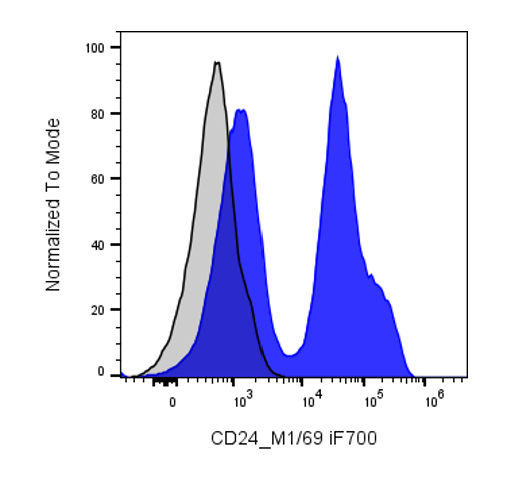
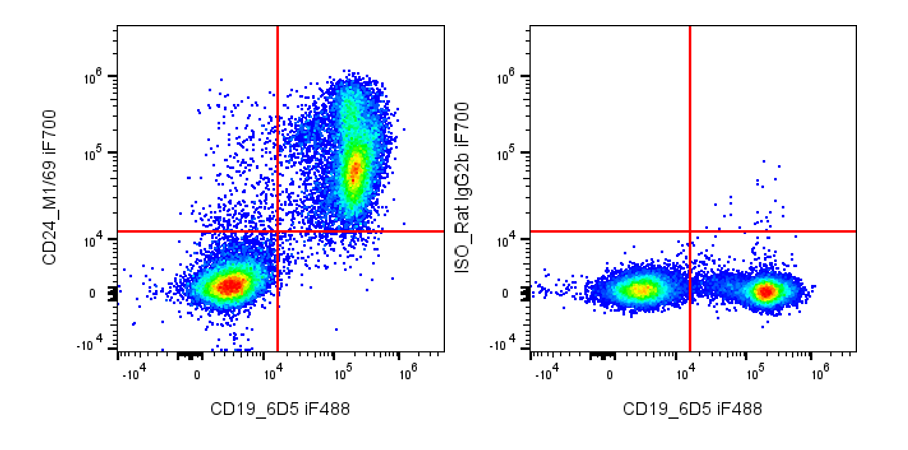
| C57BL/6 Mouse splenocytes were co-stained with iF488 Anti-Mouse CD19 clone 6D5 and iF700 Anti-Mouse CD24 clone M1/69 (left) or an isotype control (right). | |
| Storage & Handling | The antibody solution should be stored undiluted between 2°C and 8°C, and protected from prolonged exposure to light. Do not freeze. |
| See All Formats | Clone M1/69 |
Mouse CD24, also known as heat-stable antigen (HSA), is a small, highly glycosylated cell-surface protein encoded by the Cd24a gene. It plays important roles in immune-cell development, cell adhesion, lymphocyte activation, and regulation of inflammatory responses. CD24 is expressed on various cell types, including developing B lymphocytes, granulocytes, hematopoietic progenitor cells, and certain epithelial and neural cells. Its expression pattern varies with tissue type and developmental stage, making it a useful marker for identifying and characterizing specific immune-cell populations in mice.
Mouse CD24 is a glycosylphosphatidylinositol (GPI)-anchored protein that lacks a conventional transmembrane region and intracellular signaling domain. Its protein backbone is relatively small but carries extensive N-linked and O-linked carbohydrate modifications, which account for much of its apparent molecular mass and contribute to its biological activity. CD24 mediates cellular interactions through its glycosylated extracellular surface. Important binding partners include P-selectin and Siglec-G, the mouse functional counterpart of human Siglec-10. CD24 can also participate in interactions with other cell-surface molecules involved in adhesion and immune regulation.
CD24 contributes to immune homeostasis by regulating inflammatory signaling and immune-cell responses. Its interaction with Siglec-G can suppress excessive inflammatory responses by limiting signaling triggered by damage-associated molecular patterns (DAMPs), including HMGB1 and heat-shock proteins. Dysregulated CD24 expression or signaling has been implicated in autoimmune inflammation, tissue injury, and cancer biology. In some tumor models, elevated CD24 expression may help cancer cells evade macrophage-mediated immune clearance.
Therapeutically, mouse CD24 is an important target for studying immune regulation and cancer immunotherapy. Modulating the CD24–Siglec-G pathway may help control excessive inflammation and tissue damage, while blocking this pathway may enhance macrophage-mediated tumor clearance. CD24-directed antibodies and related approaches are also useful research tools for investigating immune-cell development, differentiation, and tumor biology.
iF700 Rat IgG2b Isotype Control
iF700 Anti-mouse CD24 Antibody TDS
Have a product or application question? Consult our FAQs or contact us.