| Cat # | Size | Price | Quantity | |
|---|---|---|---|---|
| 203811 | 25 tests | $80 | ||
| 203812 | 100 tests | $185 |
| Clone | PK136 |
|---|---|
| Application | Flow Cytometry |
| Reactivity | Mouse |
| Format | iF700 |
| Target Name | NK-1.1, CD161, NKR-P1C, NKR-P1B, Ly-55 |
| Isotype | Mouse IgG2a |
| Antibody Type | Monoclonal |
| Regulatory Status | RUO |
| Formulation | Phosphate-buffered solution, pH 7.2, containing 0.09% sodium azide and 0.2% (w/v) BSA |
| Protein Concentration | Supplied at a lot-specific concentration. |
| Storage&Handling | The antibody solution should be stored undiluted between 2°C and 8°C, and protected from prolonged exposure to light. Do not freeze. |
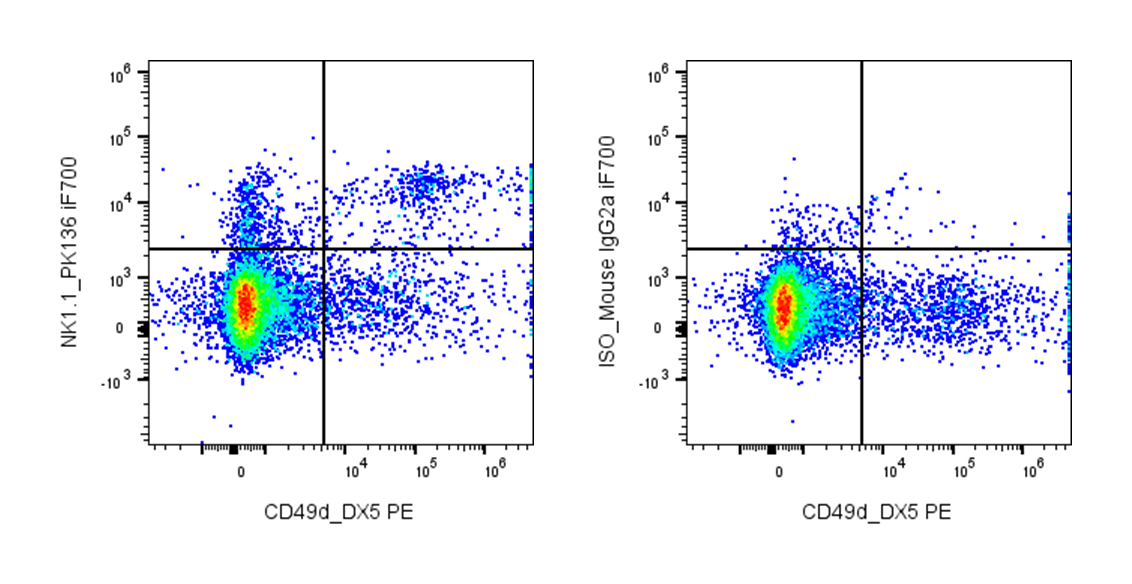
| Recommended Usage | For flow cytometric staining, it is recommended to use 5 µL of this reagent per 0.5-1.0 million cells in a 100 µL volume. Optimal reagent performance should be determined by titration for each specific application. iF700 has an excitation max at 690 nm and an emission max at 710 nm. |
| Excitation Laser | Red Laser (633 nm) |
| Research Areas | NK cells, MAIT cells, Th17 cells, Inflammation |
| See All Formats | Clone PK136 |
Mouse NK1.1 is a cell surface antigen commonly used as a marker for identifying natural killer (NK) cells in certain mouse strains, particularly C57BL/6. The NK1.1 antigen corresponds to NKR-P1C (also called Klrb1c), a member of the C-type lectin-like receptor family expressed primarily on NK cells and a subset of T lymphocytes known as natural killer T (NKT) cells. NK1.1 plays an important role in innate immunity by contributing to the recognition and elimination of virus-infected cells and tumor cells.
Structurally, NK1.1 is a type II transmembrane glycoprotein with an intracellular N-terminal region, a single transmembrane segment, and an extracellular C-type lectin-like domain responsible for ligand recognition. Unlike classical lectins, this domain typically recognizes protein ligands rather than carbohydrates. NK1.1 functions as an activating receptor, and engagement of the receptor can trigger signaling pathways that promote NK cell activation, cytokine production, and cytotoxic responses.
Known ligands for NK1.1 family receptors include molecules related to the Clrb (C-type lectin-related) proteins, such as Clr-b expressed on normal cells. These interactions help NK cells distinguish healthy cells from stressed or transformed cells. When normal ligand expression is altered, NK cells may become activated and target the abnormal cells for destruction.
NK1.1-expressing cells are important in immune defense against infections and cancer, but excessive activation may contribute to inflammatory diseases or tissue damage. In experimental mouse models, antibodies against NK1.1 are widely used to identify or selectively deplete NK cells and NKT cells. This approach allows researchers to study the role of these cells in tumor immunity, viral infections, autoimmune diseases, and immunotherapy development.
iF700 Mouse IgG2a Isotype Control
iF700 Anti-Mouse NK-1.1 Antibody TDS
iF647 Anti-Mouse CD49b (pan-NK, integrin α2) Antibody, Clone DX5
PE Anti-Mouse CD49b (pan-NK, integrin α2) Antibody, Clone DX5
In Vivo Star Anti-Mouse NK1.1 Antibody, Clone PK136
Have a product or application question? Consult our FAQs or contact us.