| Cat # | Size | Price | Quantity | |
|---|---|---|---|---|
| 108011 | 25 tests | $120 | ||
| 108012 | 100 tests | $260 |
| Clone | 4B4-1 |
|---|---|
| Application | Flow Cytometry |
| Reactivity | Human |
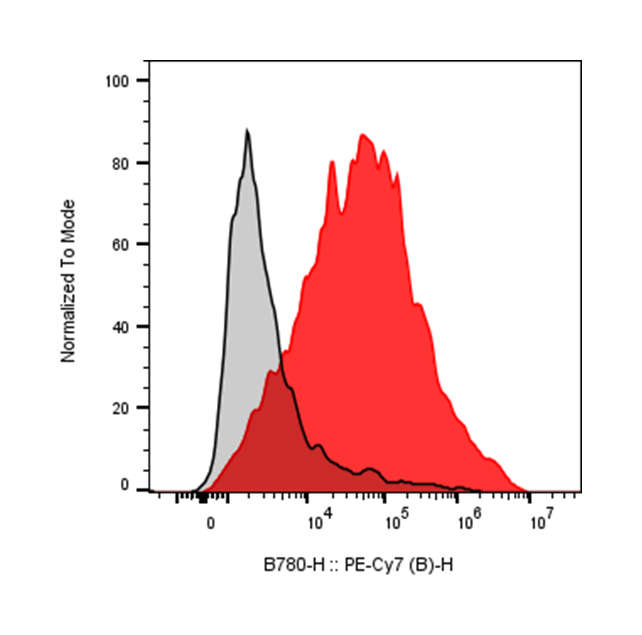
| Format | PE/Cyanine7 |
| Target Name | CD137, 4-1BB, ILA, CD-137, TNFRSF9 |
| Isotype | Mouse IgG1 |
| Antibody Type | Monoclonal |
| Regulatory Status | RUO |
| Formulation | Phosphate-buffered solution, pH 7.2, containing 0.09% sodium azide and 0.2% (w/v) BSA |
| Protein Concentration | Supplied at a lot-specific concentration. |
| Storage&Handling | The antibody solution should be stored undiluted between 2°C and 8°C, and protected from prolonged exposure to light. Do not freeze. |
| Recommended Usage | For flow cytometric staining, it is recommended to use 5 µL of this reagent per 0.5-1.0 million cells in a 100 µL volume. Optimal reagent performance should be determined by titration for each specific application. PE/Cyanine7 has an excitation max at 565 nm and an emission max at 774 nm. |
| Excitation Laser | Blue Laser (488 nm) Green/Yellow laser (532/561nm) |
| Research Areas | Activated T cells, Activated NK cells, Activated Endothelial cells, Cancer Immunology, Autoimmunity, Inflammation, Co-stimulation |
| See All Formats | Clone 4B4-1 |
CD137, also known as 4-1BB or TNFRSF9, is a costimulatory receptor that plays an important role in regulating immune responses, particularly those mediated by T lymphocytes and natural killer (NK) cells. CD137 is a member of the tumor necrosis factor receptor (TNFR) superfamily and is expressed primarily on activated immune cells, including CD8+ T cells, CD4+ T cells, NK cells, dendritic cells, and some myeloid cells. Its expression is typically low on resting cells but is rapidly upregulated following antigen recognition or immune activation. CD137 signaling enhances cell survival, proliferation, cytokine production, and cytotoxic activity, making it a key regulator of adaptive and innate immune responses.
Structurally, CD137 is a type I transmembrane glycoprotein consisting of an extracellular domain with several cysteine-rich repeats characteristic of TNFR family members, a single transmembrane region, and a cytoplasmic signaling domain. Unlike receptors that contain intrinsic enzymatic activity, CD137 signals through the recruitment of intracellular adaptor proteins. When activated, the cytoplasmic region interacts with TNF receptor–associated factors (TRAFs), particularly TRAF1 and TRAF2. These interactions trigger downstream signaling pathways such as NF-κB, MAPK, and PI3K–AKT, which promote cell survival and functional activation.
The natural ligand for CD137 is CD137 ligand (CD137L), also known as 4-1BBL or TNFSF9. CD137L is primarily expressed on antigen-presenting cells including dendritic cells, macrophages, and B cells. Engagement of CD137 by CD137L occurs during immune synapse formation between antigen-presenting cells and activated T cells. This interaction provides a secondary costimulatory signal that strengthens T cell responses following T cell receptor (TCR) engagement. CD137 signaling is particularly important for sustaining the expansion and long-term survival of cytotoxic CD8+ T cells.
CD137 has been implicated in a variety of diseases, especially cancer, chronic infections, and autoimmune conditions. In the context of tumors, CD137 signaling can enhance anti-tumor immunity by boosting the cytotoxic function and persistence of CD8+ T cells and NK cells. However, dysregulated or excessive activation of this pathway may contribute to inflammatory or autoimmune responses. In experimental models, CD137 signaling has also been shown to influence immune regulation in conditions such as viral infections and inflammatory diseases.
Because of its strong immune-activating properties, CD137 has become an important target in immunotherapy. Agonistic antibodies that stimulate CD137 are being investigated as cancer treatments, aiming to amplify anti-tumor T cell responses. Additionally, CD137 signaling domains are commonly incorporated into chimeric antigen receptor (CAR) T cell constructs, where they provide potent costimulatory signals that enhance CAR-T cell persistence and effectiveness. These therapeutic approaches highlight the central role of CD137 in modulating immune activation and improving immune-based therapies.
PE/Cyanine7 Mouse IgG1 Isotype Control Antibody
PE/Cyanine7 Anti-Human CD137 (4-1BB) Antibody TDS
Human 4-1BBL/TNFSF9 Protein (N-Fc)
Human 4-1BBL/TNFSF9 Protein (N-His)
Human CD137/4-1BB/TNFRSF9 Protein (C-His-Avi)
Biotin Human CD137/4-1BB/TNFRSF9 Protein (C-His-Avi)
Human CD137/4-1BB/TNFRSF9 Protein (C-His)
PE Human CD137/4-1BB/TNFRSF9 Protein (C-His)
APC Human CD137/4-1BB/TNFRSF9 Protein (C-His)
Human CD137/4-1BB/TNFRSF9 Protein (C-Fc-Avi)
Have a product or application question? Consult our FAQs or contact us.