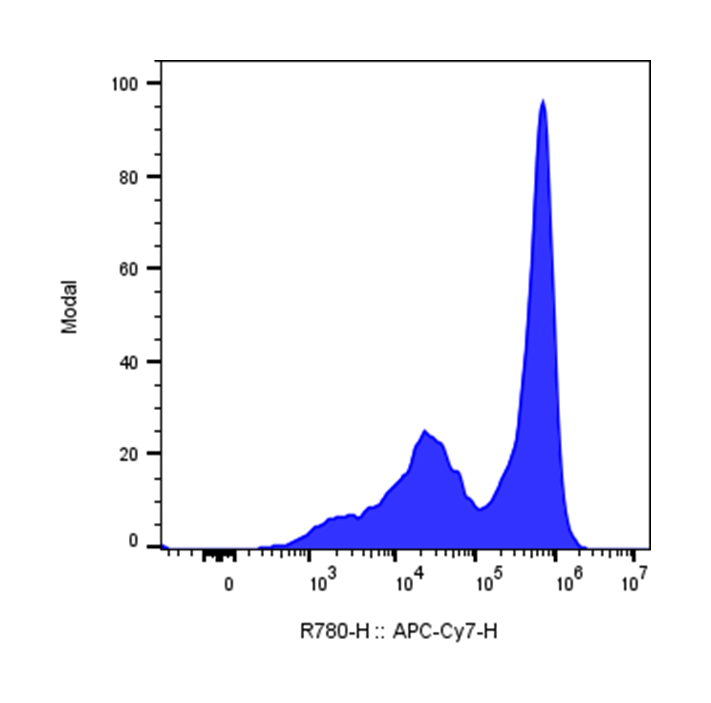
| Cat # | Size | Price | Quantity | |
|---|---|---|---|---|
| 200717 | 25 tests | $80 | ||
| 200718 | 100 tests | $240 |
| Clone | 1A8 |
|---|---|
| Application | Flow Cytometry |
| Reactivity | Mouse |
| Format | APC/Cyanine7 |
| Target Name | Ly-6G, Lymphocyte antigen 6 complex, locus G, Gr-1 |
| Isotype | Rat IgG2a |
| Antibody Type | Monoclonal |
| Regulatory Status | RUO |
| Formulation | Phosphate-buffered solution, pH 7.2, containing 0.09% sodium azide and 0.2% (w/v) BSA |
| Protein Concentration | Supplied at a lot-specific concentration. |
| Storage&Handling | The antibody solution should be stored undiluted between 2°C and 8°C, and protected from prolonged exposure to light. Do not freeze. |
| Recommended Usage | For flow cytometric staining, it is recommended to use 5 µL of this reagent per 0.5-1.0 million cells in a 100 µL volume. Optimal reagent performance should be determined by titration for each specific application. APC/Cyanine7 has an excitation max at 650 nm and an emission max at 774 nm. |
| Excitation Laser | Red Laser (633 nm) |
| Research Areas | Neutrophils, plasmacytoid Dendritic cells |
| See All Formats | Clone 1A8 |
Mouse Ly-6G (commonly referred to as Gr-1 when detected with certain antibodies) is a cell surface protein widely used as a marker for murine neutrophils. It is encoded by the Ly6g gene and belongs to the Ly6/uPAR (urokinase-type plasminogen activator receptor) superfamily. Ly-6G expression is highly restricted to mature neutrophils and their immediate precursors in mice, making it a valuable tool for identifying and studying these cells in immunological research. Historically, the Gr-1 antibody recognized both Ly-6G and the related molecule Ly-6C, but more specific antibodies are now commonly used to distinguish neutrophils from other myeloid populations.
Structurally, Ly-6G is a small glycosylated protein of approximately 25 kDa that is anchored to the cell membrane through a glycosylphosphatidylinositol (GPI) linkage. Like other members of the Ly6 family, it contains multiple conserved cysteine residues that form disulfide bonds, creating a compact three-fingered protein fold. Because it is GPI-anchored rather than transmembrane, Ly-6G lacks an intracellular signaling domain. As a result, its biological functions are thought to involve interactions with other membrane proteins or participation in cell adhesion and migration rather than direct signal transduction.
The precise endogenous ligands for Ly-6G remain poorly defined. However, the protein is believed to contribute to neutrophil activation, adhesion, and trafficking during inflammatory responses. Experimental studies suggest that Ly-6G may influence neutrophil interactions with endothelial cells and components of the extracellular matrix during migration from the bloodstream into tissues.
Ly-6G plays an important role in the study of inflammatory and infectious diseases because neutrophils are key mediators of innate immunity. Excessive or dysregulated neutrophil recruitment contributes to tissue damage in conditions such as sepsis, autoimmune disorders, and acute lung injury. In research settings, antibodies targeting Ly-6G are frequently used to selectively deplete neutrophils in mice, allowing investigators to examine the role of these cells in infection, cancer, and inflammatory diseases. While Ly-6G itself is not currently a therapeutic target in humans, it serves as a critical experimental marker for understanding neutrophil biology and evaluating potential anti-inflammatory therapies.
APC/Cyanine7 Rat IgG2a Isotype Control Antibody
APC/Cyanine7 Anti-Mouse Ly-6G (Gr-1) Antibody TDS
iF647 Anti-Mouse CD11a Antibody, Clone M17/4
PE Anti-Mouse/Human CD11b (Integrin αM) Antibody, Clone M1/70
Have a product or application question? Consult our FAQs or contact us.